SINGLETREE PROJECT COMBINES TECHNOLOGY AND SUSTAINABLE FOREST MANAGEMENT
KOKO Forest has been working within the SingleTree project on developing remote sensing-based methods for monitoring forests and individual trees. Our focus has been on building and testing dead tree detection models across different Living Lab areas, where forest structure, terrain, and environmental conditions vary significantly. These diverse environments provide a valuable setting to evaluate how deep learning-driven dead tree detection methods perform across different forest types, and how the resulting data can support more informed forest management and decision-making in the future.
High-resolution satellite imagery has been one of our key data sources. It enables us to observe large forest areas consistently and efficiently over time. In the Living Lab context, this makes it possible to monitor forest health and change across multiple regions using a shared analytical approach. The main strength of satellite data lies in its scalability and ability to provide continuous, landscape-level insight.
Another key area of development is image preprocessing and normalization. Differences in vegetation, lighting conditions, imaging angles, atmospheric conditions, and sensors cause the pixel values of the same target to vary from one image to another. In addition, due to imaging angles and inaccuracies in georeferencing, the same object may appear in slightly different locations across images. During the project, we have worked to address these challenges in order to enable more accurate and efficient continuous temporal mapping of dead trees in the future.
A major advantage of satellite data is its ability to provide a consistent view of large forest areas over time. This enables monitoring forest conditions across multiple areas simultaneously and detecting changes efficiently. For KOKO Forest, the project’s core value lies in developing new analytical methods and applying them in different forest environments together with international partners. More broadly, the project supports sustainable forest use and the development of digital forest solutions. In the future, similar methods could help forest owners, researchers, and other forestry stakeholders access more up-to-date information on forest conditions and support more efficient and sustainable forest management.
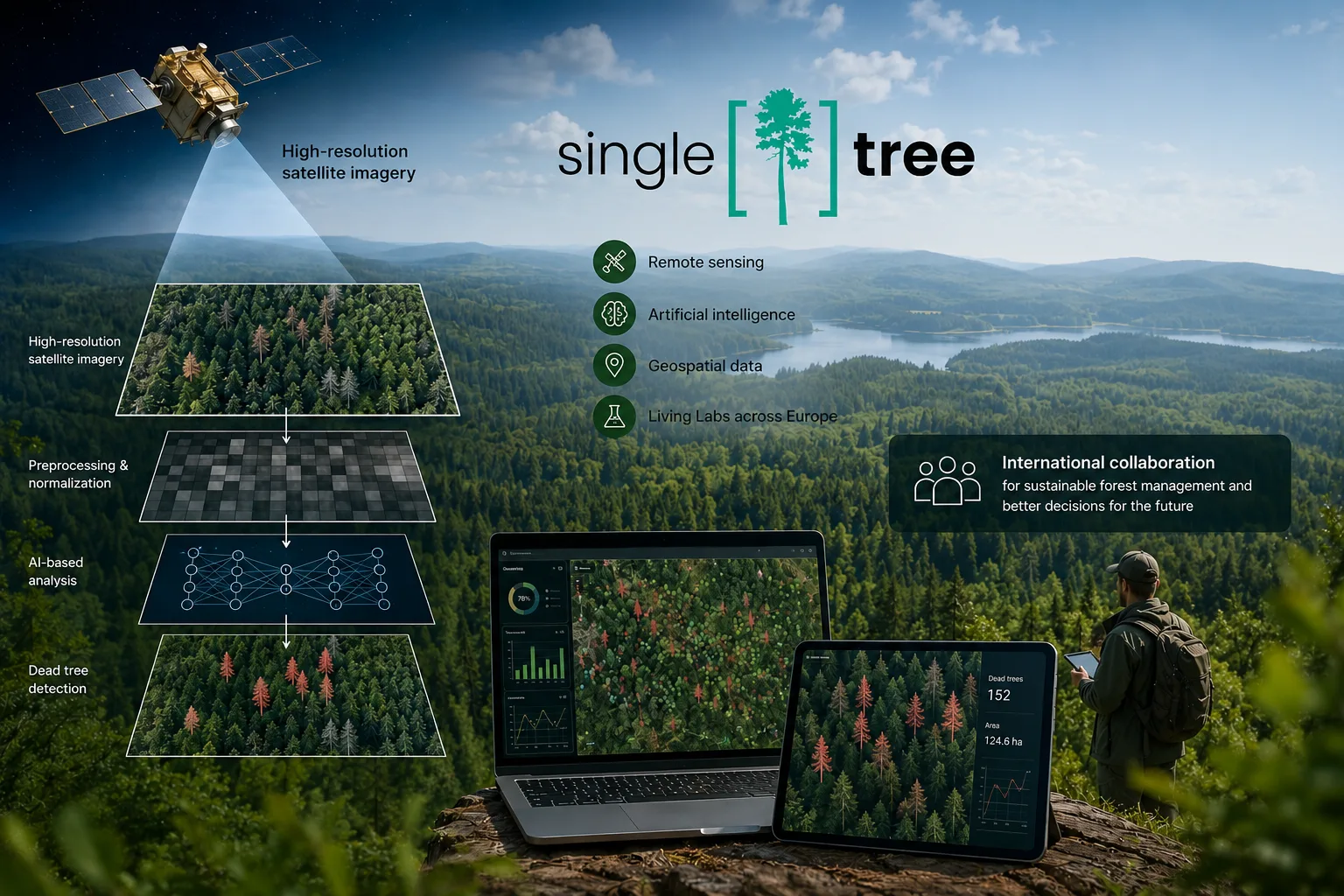
KOKO Forest develops AI- and satellite image-based methods for forest monitoring and dead tree detection across diverse forest environments in SingleTree project.