INTELLIGENT FOREST ANALYTICS IN NEAR REAL-TIME
KOKO Forest creates novel insights into forest ecosystems using state-of-the-art satellite technologies, artificial intelligence and cross-disciplinary ecological knowhow. We provide unique science-based solutions that provide near real-time information on forest ecosystems enabling sustainable management of forests in any part of the world. We bring the intelligence to Earth observation data and combine it with profound understanding of ecosystems and plant functions for improved forest-related decision-making in the society. We aim to be the global leader in satellite-based forest analytics and services.

SERVICES

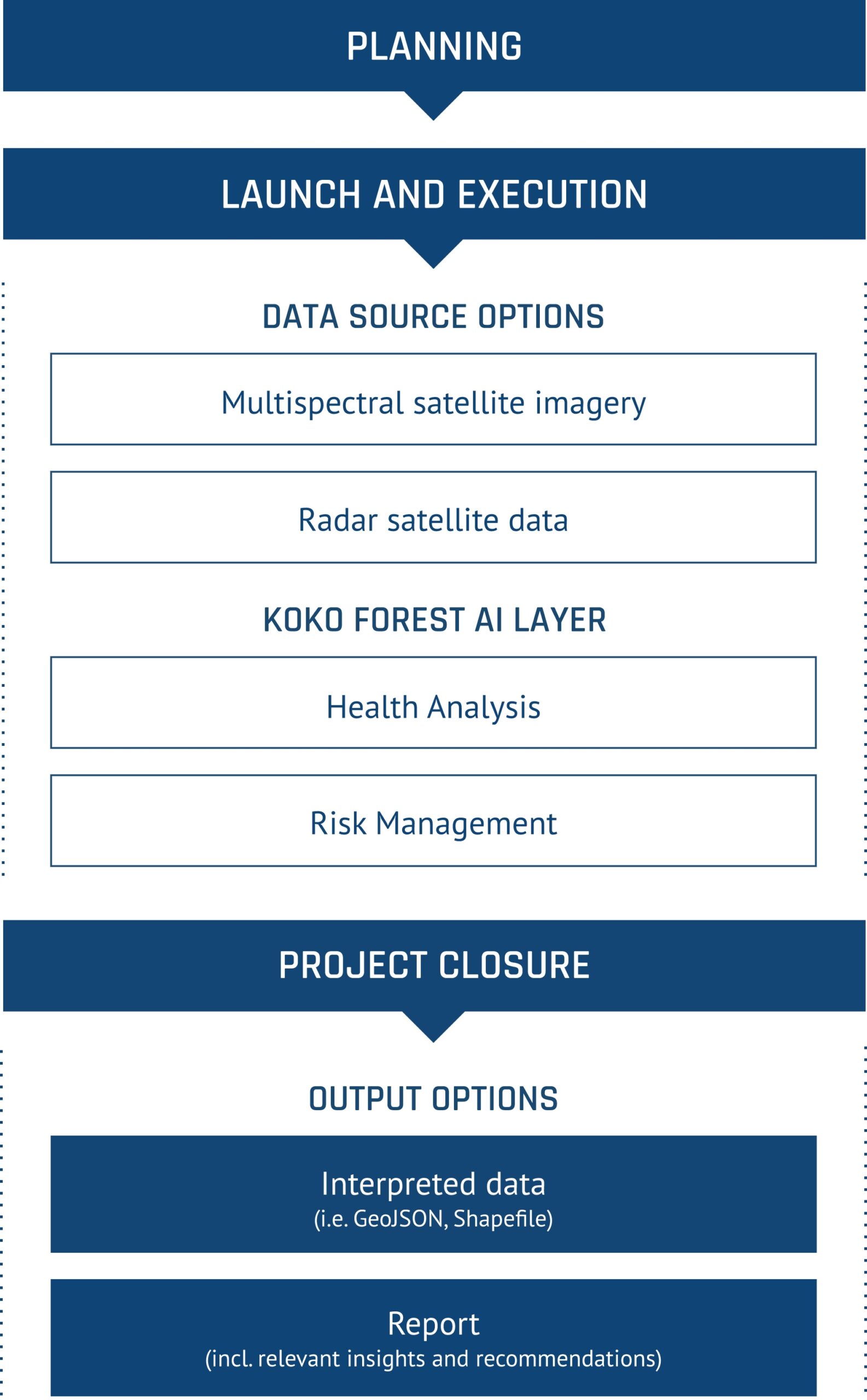
KOKO Forest Health Analysis provides near real-time information on the health and condition of forests using Earth observation data and artificial intelligence.

KOKO Forest Risk Management provides estimates of tree mortality risks, helping identify areas vulnerable to forest damage and enabling more targeted forest risk management.
KOKO Forest Biodiversity provides geospatial estimates of Nature Value Hectares (LHA), supporting the identification and assessment of forest ecological condition.
SATELLITE TECHNOLOGIES AND REMOTE SENSING
We utilize the latest satellite technologies that enable us to monitor forests anywhere anytime. Our eyes can observe only a tiny part of the electromagnetic spectrum (visible light), but novel sensor technologies on board the satellites allow us to utilize a wide range of different parts of the electromagnetic spectrum. As each part of the spectrum contains different types of information from the environment, we are able to analyze various changes that occur in forests. For example, microwave wavelengths enable us to detect structural changes in forests, such as logging events or storm damages, whereas optical wavelengths enable us to detect changes in forest health and condition. We select our data sources based on the application for optimal performance and the selection is always based on the latest scientific knowledge.

FOREST HEALTH ANALYSIS
KOKO Forest Health Analysis is a near real-time analysis of forest health and condition using the latest satellite space technologies, remote sensing and artificial intelligence. We provide custom-tailored solutions to our customers to ensure they have the information they need to maintain forests in good health, be up-to-date on forest damage events and ensure the ecosystem services they provide. We have eyes on every forest in the world to provide the latest forest health data from anywhere and anytime.
Do you want to know if trees in your forests are still alive?
One of the most pressing ecological questions is how trees and forests can survive in increasing intensity and frequency of droughts and extreme heat. Wide-spread drought-related tree mortality has been witnessed globally over the last decade and in 2022, Europe suffered from the worst drought in 500 years. Climate change and bark beetle epidemies are a serious threat to the ecosystem services they provide, including their economic value. Forest owners in the US have lost about $1.2 billion due to a single bark beetle species (Southern pine beetle) by 2004 (Pye et al. 2004) and in the Czech Republic, the European spruce bark beetle caused a revenue loss of over 260 M€ during 2018-2019 (Hlásny et al. 2021). Warmer climate and increased frequency and duration of droughts enable bark beetles to reproduce in unmet numbers. The timber volume damaged by bark beetles in Europe has grown exponentially recently and was over 70 M m3 in 2019 (Patacca et al. 2022). We are on a very worrying trajectory regarding the health of our forests and we want to help our customers to make better decisions in the face of climate change to maintain the vitality of forests globally.
Reference list
PATACCA, M., LINDNER, M., LUCAS‐BORJA, M. E., CORDONNIER, T., FIDEJ, G., GARDINER, B., … & SCHELHAAS, M. J. (2022). SIGNIFICANT INCREASE IN NATURAL DISTURBANCE IMPACTS ON EUROPEAN FORESTS SINCE 1950. GLOBAL CHANGE BIOLOGY.
PYE, J. M., HOLMES, T. P., PRESTEMON, J. P., & WEAR, D. N. (2011). ECONOMIC IMPACTS OF THE SOUTHERN PINE BEETLE. IN: COULSON, RN; KLEPZIG, KD 2011. SOUTHERN PINE BEETLE II. GEN. TECH. REP. SRS-140. ASHEVILLE, NC: US DEPARTMENT OF AGRICULTURE FOREST SERVICE, SOUTHERN RESEARCH STATION. 213-222., 140, 213-222.
HLÁSNY, T., ZIMOVÁ, S., MERGANIČOVÁ, K., ŠTĚPÁNEK, P., MODLINGER, R., & TURČÁNI, M. (2021). DEVASTATING OUTBREAK OF BARK BEETLES IN THE CZECH REPUBLIC: DRIVERS, IMPACTS, AND MANAGEMENT IMPLICATIONS. FOREST ECOLOGY AND MANAGEMENT, 490, 119075.
We provide up-to-date information on the condition and health of forests from anywhere in the world. Tree mortality has increased nearly exponentially in every continent of the world due to climate change. Bark beetle outbreaks have caused devastating losses both ecologically and economically. The economic value of a forest stand can decrease by 80% during a single year due to a bark beetle outbreak and we provide the information that helps to mitigate these losses.
PROJECT TEMPLATE

PROJECT TEMPLATE

FOREST RISK MANAGEMENT
KOKO Forest Risk Management provides comprehensive information related to the climate risks on forests. Climate change has pushed forest ecosystems towards instability, which has been observed as huge increases in forest damages and tree mortality globally (Allen et al. 2015). The vitality of forests and the ecosystem services they provide can no longer be guaranteed in the future, whether they were carbon sequestration as a nature-based climate solution or as a source of timber. We help our customers to assess the risks related to their forest assets and provide management solutions that help in reducing the risks and increase the stability of their forests.
Would you like to know whether trees will survive in your forests in the future?
Climate change imposes huge risks on forests globally due to increased frequency of disturbances, such as drought, bark beetle outbreaks and wildfires, threatening the ecosystem services they provide (Anderegg et al. 2022). Forests are at the core of mitigating climate change and sequestering human-induced carbon emissions, but climate induced stress can transform forests from carbon sinks to carbon sources (Brodribb et al. 2020). We use satellite data, climate analysis and ecophysiological knowledge at the frontiers of science to help our customers to assess the climate risks of forests from now to 50 years in the future. We help forest owners to make better decisions decades in advance and avoid catastrophic consequences before it’s too late. Large investments in the forest sector are made based on limited information of the trajectory of forest growth and mortality and we help our customers to assess these risks.
ALLEN, C. D., BRESHEARS, D. D., & MCDOWELL, N. G. (2015). ON UNDERESTIMATION OF GLOBAL VULNERABILITY TO TREE MORTALITY AND FOREST DIE‐OFF FROM HOTTER DROUGHT IN THE ANTHROPOCENE. ECOSPHERE, 6(8), 1-55.
ANDEREGG, W. R., WU, C., ACIL, N., CARVALHAIS, N., PUGH, T. A., SADLER, J. P., & SEIDL, R. (2022). A CLIMATE RISK ANALYSIS OF EARTH’S FORESTS IN THE 21ST CENTURY. SCIENCE, 377(6610), 1099-1103.
BRODRIBB, T. J., POWERS, J., COCHARD, H., & CHOAT, B. (2020). HANGING BY A THREAD? FORESTS AND DROUGHT. SCIENCE, 368(6488), 261-266.

FOREST BIODIVERSITY ANALYSIS
KOKO Forest Biodiversity provides spatially explicit information on forest biodiversity by combining Earth Observation, AI and ecological modelling. The product is designed to complement field-based biodiversity assessments and make biodiversity information available across larger areas and at a level of detail relevant for practical decision-making.
The solution uses multiple data sources, including satellite and aerial imagery, airborne LiDAR and field reference data, to identify and quantify characteristics that are closely linked to biodiversity. These include deadwood, large deciduous trees, tree species composition and forest structural diversity. By integrating individual indicators into a consistent assessment framework and a single biodiversity metric, the product helps identify areas of high ecological value as well as opportunities for restoration.
Forest Biodiversity is built on strong ecological research and transparent biodiversity metrics. The product is developed together with Luontoa Oy, combining KOKO Forest’s expertise in remote sensing, geospatial analytics and AI with Luontoa’s expertise in biodiversity measurement, regulation and the practical use of nature data.
Measure forest biodiversity consistently, efficiently and at scale
The solution supports applications ranging from forest management and conservation planning to biodiversity reporting, investment analysis and nature-positive land-use decisions. The product is being further developed through funding from the European Space Agency, with the aim of making reliable biodiversity measurement increasingly scalable and repeatable.
WE ARE TRANSFORMERS
Our vision is to aid in the transformation towards a human society that is able to live within the planetary boundaries.
We will use 10% of our profits for funding the protection of forest ecosystems and for supporting non-profit projects that enhance planetary well-being.
Sustainable development is at the core of our values. We believe that ecological sustainability, which takes into account the boundaries of our planet, sets the frame for social and economical sustainability. We believe in science and the intrinsic value of new knowledge. We believe in a just green transition and want to do our share to speed up the green transformation of human societies.
SALES & INQUIRIES
Contact us for comprehensive information about the state of the world’s forested ecosystems.
TRUSTED BY